Homilies

The Temptation of the Elder Son
Sunday, January 31, 2010
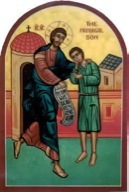
The Prodigal Son
Introduction: on imitating the younger son
This parable of Christ is designed to awake repentance in our hearts. We are to follow the movement of the Prodigal son through the story so that we, like him: embrace the longing for the better life in our Father’s house; recognize how far our lives are from the perfection we desire; acknowledge and repent of the many things that we have done to separate ourselves from the things we truly desire; then turn our back on our bad conduct and accept the arms of our Father who comes running to greet us.
In other words, we are to consider how much we are like the prodigal son of the story and then imitate his repentance and return towards righteousness. If you need help identifying the sorts of behaviors and attitudes that led you to forsake your Father’s house, then I encourage you to exercise your spiritual muscles of repentance using the workout I recommended last week: find and accept responsibility for all the many troubling things that happen around you. If this is too hard, then you can always consult your prayer book’s section on preparing for Confession. It is very useful for this purpose.
Today’s epistle provides yet another opportunity for learning repentance: if you recognize your body as a member of Christ’s body, then you will automatically recoil from sin and do good. As Saint Paul asks; “Would you try to join Christ’s body to that of a harlot?”; and we continue; “Would you pollute Christ’s body with drugs and excessive liquor?” It is kind of like the advice parents give to their teenagers; “don’t do anything you wouldn’t want your grandmother to see you doing.” This kind of exercise contextualizes your actions, allowing you too see their moral dimension: if you are able to recognize the things that would bring shame to your blessed grandmother – or be incompatible with the loving perfection that is Christ – then you have begun to “come to yourself” as did the Prodigal in today’s Gospel.
On the sin of the older brother
But you have heard all this before. You understand that when Christ shares a parable, you are to think of the many ways you resemble the villain in the story. But the son who demands his share, leaves his true home, and wastes his inheritance and his life in wickedness is only one of the villains in the parable of the prodigal son. I would like to focus the remainder of my remarks on the other villain in this story: the older brother. You know; the one who (supposedly) never left his father’s house. And while we hear his story, I want you to try to recognize the many ways you are like him.
How is he a villain? Perhaps it is obvious: not only didn’t he emulate his father’s joy at the repentant return of the prodigal - he opposed it with his own anger! Not only didn’t he go and join in the feast - he complained that he never got a feast of his own! Not only didn’t he forgive his brother – he questioned the righteousness of his father’s action. You can imagine that if he had been the one to meet his brother, he would either have turned him away, or – in his own idea of mercy – accepted his brother’s desire to live as one the household servants. Or, perhaps he would have imitated our own infatuation within back dues by demanding that his brother first return the share he had wasted!
It is tempting to think that the older brother only really sinned when the prodigal returned. But, as with the heretical Old Believers I described last week, the return of the prodigal only brought to light the darkness and pride that had been growing in the older brother’s heart for quite some time. He may have been with his father physically, but it sounds like he had left his father’s way of life long ago.
The future of the older brother: two paths to chose from
The story leaves us hanging about the future of the older brother and how his story ends. But we can imagine two paths his life might take.
The first is the way of pride, and it is very popular. In this ending, the older son continues to condemn his father for the way he runs his household. Like his brother before him, he demands his share of the inheritance and leaves. But instead of spending the money on “riotous living” like his younger brother did, he sets up his own household where things would be done “correctly” and “by the book.”
You can see just how popular this option is when you look at the proliferation of independent Protestant denominations here in the United States and even of Orthodox jurisdictions in Ukraine. With very few exceptions, each of these was formed in an attempt to do things better than they were done in the father’s house.*** More importantly, it is the way we chose when we design and follow our own spiritual paths that do not involve Christ and the Mysteries of His Church.
But the strong temptation of this way predates even the first schism from Orthodoxy: long before men walked the earth, in a storyline that strongly resembles that of the older brother in today’s parable, Lucifer chose this path. Pious tradition teaches that it was God’s plan to elevate the second born rational creatures – mankind – above the firstborn angelic hosts that led to Lucifer’s revolt. Like the older son in the parable, he could not abide in a household that operated on the basis of love – he preferred one based on justice and merit.
The hell that we create when we build our own households apart from God are no less diabolical.
This first story path does not end well, but it is not the only possible outcome.
In the second version of this story, the older brother repents. He recognizes how pride has ruined his life and how it has separated him from both his father and his brother. He asks for their forgiveness, receives it, and then joins them in the feast.
This is the ending that I like, and it is open to all of us for there is only one Feast and we are all Prodigal.
Conclusion
I am the prodigal. “I have wasted the riches which the father gave me; I have spent them all and am now destitute.” [Matins]
I am the older son. I have rejected my repentant brother and have questioned my Father’s love.
“O Lord, I have sinned against heaven and in your sight, and am no longer worthy to be called your son. Receive me in repentance and have mercy on me.” [Gospel reading and Matins]
In the name of the Father, and of the Son, and of the Holy Spirit. Amen.
---------
*** Some of these new “churches” were actually formed as folks left the “older brother’s new house of pride” to form their own – the multiplication of pride is enormous. Thank God some of these eventually end up back in the Father’s house! This is an important dynamic, but a bit involved for a homily. I hope that the reader will forgive the simplification.
The Prodigal Son

I am the prodigal. I have wasted the riches which the father gave me; I have spent them all and am now destitute. I am the older son. I have rejected my repentant brother and have questioned my Father’s love.
O Lord, I have sinned against heaven and in your sight, and am no longer worthy to be called your son. Receive me in repentance and have mercy on me.
Picture: This icon is by the hand of Nicholas Papas. It is from St. George’s AOC in Oakland, PA. Click icon for purchase information.