Homilies

Help My Unbelief
Sunday, March 29, 2009
“Lord, I believe; help my unbelief!”
There is so much wisdom in this one line. We are all Orthodox Christians. Every week during Liturgy we affirm our commitment to the fundamental Truth of Orthodoxy by reciting the Creed; “Again, and again” we “commend ourselves and one another to Christ our God”; we admit that in a world where Love is Sovereign that; “it is right in truth, to worship the Father and the Son and the Holy Spirit: the Trinity, One in Essence and Undivided”; we state our belief that Communion is truly the “Most Pure Body” and “Precious Blood” of the “Son of the living God” and [state] our desire that it acts within us for the “remission of sins”, “life eternal” and the “healing of soul and body”; and through all of our litanies we ask Our Loving Lord to have mercy on those in need [just as the father supplicated Jesus on behalf of his son].
The great theologians of the Church have written more books than we can read in a lifetime about what it is that we Orthodox Christians believe. But those books just develop and apply one fundamental and wonderful truth: that the Omnipotent God created us in love, desires our eternal joy, and has offered us this way of perfection through His Son, Jesus Christ and the Holy Spirit.
I know this to be true as surely as I know that these walls are blue. I know that the Lord loves me; I know that He will grow me into the man I was created to become: a good man, full of strength and compassion; I know that if I follow Him through the Mysteries of the Church that He will perfect me; and that He will work through me to bring His joy, peace and salvation to others. You know the same thing because you have seen the miracles He has worked in and through you.
Yes, we believe. We believe all of this. It is at the very core of who we are. Not just as Orthodox Christians, but as persons made in the image and likeness of God. We know all these things to be true and we rejoice in it.
“Lord… help my unbelief”
But that does not mean that we understand it all. We use the word “Mystery” to refer to God’s revelation because parts of it remain beyond our ken [beyond our understanding]. Our relationship with God is through the humanity of the God-man Christ. We understand the human part - the physical part - pretty well: but the “God” part… how could we possible understand it? [Fore example, we see the mundane part of our Sacraments: the bread, the wine, the water, the oil, the tears… and we see their effects on us; but do we see them in their fullness?] We are just beginning to understand the micro and macro pan-dimensional complexity of the world; why should we ever expect to understand the One who made it? As we grow in perfection, we grow in understanding; but how much must we grow to master eternity? [impossible]
There are many people in this world who are so proud that they will not commit to something they do not completely understand. But if the Truth is eternal, then they are committing themselves to a lie. It may be a lie that they understand, but it is still a lie. And lies cannot bring lasting joy. Even those of us who know the Truth are sometimes overwhelmed by it; we are tempted to trust the finite wisdom of this world and to doubt the deeper meaning. And so… we join the father [in today’s Gospel] in his prayer “Lord, I believe; help my unbelief” so that we can see His healing touch on the infirm; so that we can partake of His Body and Blood; and so that we can trust in His loving plan for us and this world.
Sunday of the Ladder
Scripture Readings

If you only commit yourself to things you understand, then you are committed to lies and half-truths.
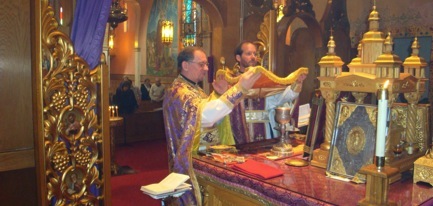
Picture: celebrating Divine Liturgy with Fr. Roman in Boston.