OrthoAnalytika

Forgiveness and the Law of Love
Sunday, March 1, 2009
Living according to the Law of Love
People still mystify me. If you ask them what it is that they truly desire, most will tell you that they desire happiness. This part makes sense: we were designed for fulfillment and love, not for misery and hopelessness. We were created for loving fulfillment. The part that mystifies me is that these same people who deeply desire happiness, do nothing to bring it about. Worse yet, they act in ways that virtually guarantee their misery. I can kind of understand it for people who don’t know what it takes to be happy: they might be excused for their failure. Like mice in a maze, hungry for the cheese they smell; they strike out in different directions, but the dead-ends they find leave them only hungry, tired, and frustrated. The world is full of frustrated people.
But we are not (or should not be) like them: as Christians we not only smell the cheese, we know exactly how to get it. God has not hidden happiness in a maze (the world does this): He has made it very clear. As we learned last week, He made this world [this creation] in love and to run according to this love. We are a part of this creation. To be happy, we need only learn to love; to submit our lives to love; to become love. How hard is that? A world made in love will naturally reward this. It certainly could be much worse.
A Brief Aside: Systems of Lies and Selfishness
[Can you imagine a system that was based on something else? One that rewarded something other than love? I doubt that you have to work hard to imagine such a system: most of you are familiar with communism. Communism created a huge bureaucracy that ran on fear and lies. To get ahead, you had to tell lies and seek alliances with powerful people; people who were powerful in part because of who they knew and in part because lying came so easily to them. Historians describe how Soviet citizens developed a kind of double-mindedness in order to preserve a little bit of sanity and honor. Devotion to love and truth gets you martyred in situations like that. Some of our predecessors here fled their homes at the first opportunity in hopes of finding something better. I pity those that did not make it out. Communism did more than destroy the economies of the former Soviet Union, it created a vast moral wasteland that will take generations to correct. High levels of abortion, alcoholism, adultery & divorce are just part of the communist legacy; the list of symptoms goes on and on.
But communism is not the only system that rewards something other than love. The maze we have built in our own country rewards some some virtues that are derived from love, like hard work and sacrifice; but it also promises to reward false virtues like selfishness, consumerism, and hedonism. Capitalism and democracy are the most efficient ways to organize production and government, but if they are separated from love they will still lead to misery. The same goes for our marriages, our families, and our parish: if they are built on something other than love then they may survive, but they will not bring what we really desire. Staying in unloving relationships requires adopting the same kind of pathologies and double-mindedness that communism did; and the legacies of living in such systems also take years of constant effort to overcome.
We need only look at troubled and broken marriages, workplaces with unhealthy environments, and communities with poisoned cultures to understand the point I am trying to make: institutions that are not based on love do not bring lasting joy. They may bring other things, like the redistribution of wealth [communism], fully stocked grocery stores [capitalism], children [marriages/families], and beautiful churches [communities/parishes], but they cannot bring real and lasting happiness.]
The Real World and the Rule of Forgiveness
So while I can understand why some people spend a lot of energy that takes them further and further away from the joy they claim to want, I cannot understand why Christians do this. God is very clear and very specific about what we need to do if we want to be happy. He tells us how to bring joy to ourselves, our families, and our communities: we must live a life of love. [How do we do this?] Last week He told us about charity and how we must care for those in need. This week He gives us detailed instructions about three more things: forgiveness, fasting, and investing. As today is Forgiveness Sunday, let me focus on it.
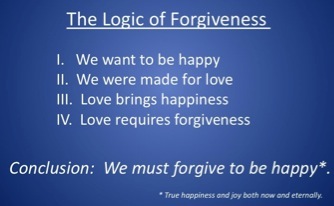
Happiness requires that we forgive people. Salvation requires that we forgive people. You cannot live a life in love if you do not forgive. So why aren’t we doing it? This is what I meant when I began my homily by saying that people mystify me; I do not understand the disconnect. Let me make the puzzle clear: We want to be happy. Happiness requires love. Love requires forgiveness. But we refuse to forgive. As a result we cannot love and we cannot be happy.
As a teacher, I have wracked my brain trying to understand which part we do not understand, but I can’t. I daresay that we understand the logic, but that it has not sunk in; love remains something that we choose to do rather than who we are. But as long as that is the case, as long as love remains one of several reasonable responses then happiness will be similarly fickle. If we can honestly chose to love one person but not another; or if we can honestly chose to forgive one person and not another; then we remain part-time Christians. If we can do this, then love for us is like an accessory. But like the baptismal Cross we wear about our necks, love has not been given to us as an accessory, worn only when it matches the clothes we are wearing. It was given to us in order to become the center and basis of our lives, just as it is of the God in whose image we are made. If we do not learn to do this, then we will not be happy. Not now, not ever, and not “forever and ever”.
We must learn to forgive. If we do not, then we must admit that we do not really care about happiness; [we must admit] that we are selfish and vain; and [we must admit] that we prefer gnawing on the poison misery of spite than the Body and Blood of Christ. I am not saying that it is easy [to forgive]. People have hurt us. Some of this pain may even have been intentionally inflicted. Overcoming this will require effort. But we have to start now. Hate does not become us; spite deforms us and makes us ugly. Moreover, its poison threatens the health of our relations and this community. We must let go of it and forgive. We must let go of it and love. Unlike spite, love will heal and beautify us.
God knows this is difficult, and as Our Great Teacher, He has given assignments that will help us gain mastery. One of these is our daily prayer rule. Repeated often enough, the prayers in our Prayer Book will teach us how to forgive. For instance, we cannot say; “Lord, save and have mercy on those who hate me and deal wrongly with me by doing me harm and do not permit them to come to condemnation because of me, as sinner” on a regular basis without it changing and healing our hearts. That is why Orthodox Christians are supposed to say it and similar prayers every morning. Today, we will complete another assignment our Great Teacher has given us: after Liturgy we will perform the Rite of Mutual Forgiveness. Each of you will forgive and ask forgiveness of everyone else. This is not empty ritual: it is one of the many things that we do to become happy.
After all, we want to be happy, don’t we?
Sunday of Forgiveness
Scripture Readings

A world made in Love rewards forgiveness with happiness.