Homilies

Where do YOU find God?
Sunday, March 15, 2009
Last week we heard how Nathaniel’s life was changed by his encounter with God-Incarnate in Jesus Christ] and how King Volodymyr’s life was changed by his encounter with God-Incarnate in the Holy Orthodox Church. Today’s Gospel lesson continues this theme by describing another life-changing encounter with God: that of the paralytic.
What I would like to do today is to use this encounter as a way to challenge you with this question: “where do YOU find God?” So many of us need His help; so many of us would benefit from the healing He offers; so many of us would enjoy the life of comfort, perfection, and joy that are found only in Him; but what are we doing about it? Rather than going where we know He is in His fullness, we claim to find Him elsewhere: in books, in time with family and friends, in meditation, maybe even in personal prayer and the study of Holy Scripture. You have your own list of things that bring your satisfaction. And while I am not debating the value of such things, they cannot serve as the basis of our healing and salvation. For this you need the living Body of Christ. For this you need to encounter Him face-to-face, and you need to make such encounters a regular part of your life.
Christ is Our Physician, and the Church is His Hospital
The four men knew the power of personal contact with Christ and they went to a lot of trouble to get their friend into His presence. But why did they bother? I am sure that people told them just as they will tell you that God can be found everywhere; that there are other sources of healing; and that this man Jesus is no better than the other prophets who make similar claims. It must have been tempting to listen to these voices and do something easier. But they bothered because they had a sense of something better: that the God who is “everywhere present and in all things” was most potent in His Christ; that there was no one who healed as well as Him; and that other prophets and traditions are but shadows and ripples of the Truth. They bothered to bring their paralytic friend to Christ because they really wanted to get him healed and saw Christ as the Great Physician that He is. If you want to be healed, you don’t just read about the doctor, or study what he did: you go and visit him.
Finding God in the Sacraments
So I ask you again, where do you find God? Where do you go for healing? One of the reasons we celebrate St. Gregory Palamas this week is because he taught that it was possible for men to know God; that communion with Him was more than an emotional, intellectual, or even simply physical experience. [He taught] That through continuous participation in the Sacraments and worship of the Church we can grow in His perfection. As we do this, our other actions – such as reading, spending time with family and friends, meditation, prayer, and study of Scripture – receive the benefit of this change within us. But these things themselves can never become the source of our perfection, and if we center our spiritual lives around them, then we will encounter less and less of God, and more and more of ourselves and the many charlatans who exploit our laziness and our pride. To make matters worse, as you separate yourself from the Mysteries and Worship of the Church, you will be less and less able to discern the difference between charlatans and your own vanity and the True Knowledge of God.
The irony is that if you Commune with God here, in His Church and in His Sacraments, then you will increasingly commune with Him elsewhere; if you seek His forgiveness here, you will increasingly enjoy His mercy in your private prayers; and that if you accept His healing care here, you will continue to enjoy health and joy at home and elsewhere.
Sunday of Gregory Palamas
Scripture Readings

Where do you find God?
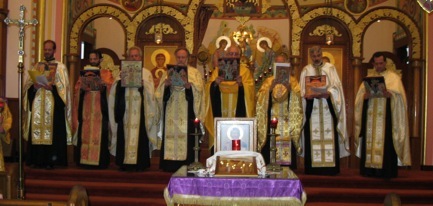
The picture is from The Pan-Orthodox Vespers for the Sunday of Orthodoxy, hosted at St. Michael’s.