OrthoAnalytika

Wall of Separation
Sunday, November 30, 2008
Before I begin, let me share the deepest love and condolences from the faithful of St. Michael’s to the parish of St. Mary’s on the falling asleep in the Lord of their beloved pastor, Ihumen Gregory. May God strengthen them during this difficult time, and may He grant their spiritual father a Memory Eternal.
St. Paul teaches us in today’s epistle that Christ has “broken down the middle wall of separation”. This is the wall that separates us from holiness and sanctification. In the beginning, we were created for eternal growth in the Lord; to grow in beauty and goodness. There was nothing between us and the realization of our full potential in community with one another and Perfection. But our sin and the resultant fallenness of the world we live in have created a great gulf between us and the goodness that we long for.
In olden days, God gave the Jews the Law so that by following it they could be brought to holiness. But, as St. Paul points out, instead of bridging the gap between their sinfulness and God’s perfection, the Law became a wall; a constant reminder of their unworthiness. You see, no one could keep the Law. No one could live without sin. So instead of serving as a guide to avoid temptations, it served as a description of all the temptations the Jews could not avoid.
Now, like anyone who is away from their homeland, we never feel quite right where we are. There is always the nagging sense that we were made for something else, something better; that the world itself is not quite right. We try to satisfy that longing with various things; you know the litany. In this promiscuous culture many of us try to quench this thirst with illicit sex of various types: adultery, pornography, self-stimulation, hook-ups... the list goes on and on. Many of us turn to alcohol and drugs. But even those of us who somehow manage to avoid these temptations are likely to fall into one much more inticing and ubiquitous: we try to satisfy ourselves with the things we buy. I love America and the capitalism that has made it strong. I believe that capitalism is the most efficient way to organize any economy. Unfortunately, it has also been incredibly successful at turning us into hedonistic and selfish consumers. Instead of bringing simple transparency to the market, the advertisers of Madison Avenue have manipulated our weaknesses to the extent that we have become addicted to buying stuff we don’t need. Their siren call has led us to blur the distinction between what we “need” and what we simply “want”; something which easy credit (what I call “easy debt”) has exacerbated to the point where we are willing to risk our families’ economic and physical security in order to buy stuff that does nothing to improve our happiness.
We keep trying to fill that “God shaped void” in our hearts with more stuff, but more stuff never fills it. Economists assume that our appetites are insatiable: they are correct in that no amount of worldly things can ever satisfy our longing. And now our economy, based at it has been on the risky satisfaction of artificially-generated needs, is coming crashing down around us. The silver lining here is that this may allow more of us to see this mockery of a market for the illusion it always has been [despite the best efforts of the government, which is attempting to dampen the effects of the crash by leading creditors away from making prudent lending decisions]. The truth that Madison Avenue tries to hide is that nothing can satisfy our primal longing except the One Thing Needful: our Lord, God, and Savior, Jesus Christ.
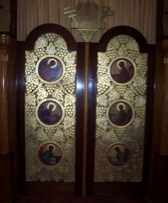
Christ has put a door through the wall that separates us from perfection. He is at that door inviting you to open it (Revelations 3:20). If you answer His call, then you can transcend the limitations of your fallenness: you can go through the wall of separation; you can cross the threshold from sinfulness to sanctification. So open it. Go through it. Find your heart’s true home.
As St. Paul says, it is Christ who, through the Cross, restores us to unity with one another and the Father. Therefore, we are “no longer strangers and foreigners, but fellow citizens with the saints and the members of the household of God.” We are members of His household. This past Thursday we celebrated Thanksgiving, a time when Americans open up their homes to family and friends and offer them our most genuine and heartfelt hospitality. We all cherish this holiday. But the hospitality shared at even the best Thanksgiving gathering is but a shadow of that shown by the Master when we become members of His household. The hospitality shown in God’s house is beyond compare. And just look at the banquet He has set for us: He has truly offered up the greatest feast imaginable; a meal that offers forgiveness and an eternity of joyful and satisfying celebration.
St. Paul finishes today’s lesson by telling us that we, being fitted together with Christ as our cornerstone, grow into a holy temple”. You can see this in your parish as it grows in holiness; as you all grow into a more fitting “dwelling place” for “God in the Spirit”. You have found the door and opened it. You are enjoying the feast. Now Christ is working within and through you so that you can show others the door. There is a world outside that is hungry; a world that is starving to death feasting on dry husks (St. Luke 15: 16) that it cannot really even afford. Here in the Lord’s house we have the food that is “broken and distributed” but “never consumed”. You are members of God’s household. You are, indeed, members of His very body. Now go do as He commands: go out into the highways and the hedges to bring our starving brothers and sisters to the feast (St. Luke 14: 16-24).
In the name of the Father, and of the Son, and of the Holy Spirit. Amen.
24th Sunday after Pentecost
Christ as the door in the wall of separation between us and our heart’s true home.
Note: I served at St. Mary’s in New Britain this Sunday, so the lectionary readings are from the Revised (New) Julian Calendar.


